Local Go Development with FlyEnv
Go is a compiled, statically typed programming language commonly used for network services, command-line tools and cloud infrastructure software. FlyEnv keeps local Go development in one app: install multiple Go versions side by side, decide which one your terminal go command resolves to, integrate with GVM on macOS and Linux, and bind each project to its own Go runtime. The Go module has five tabs — Go Projects, Service, Version Manager, New Project and GVM — covering version installation, PATH control, project runtimes and scaffolding.
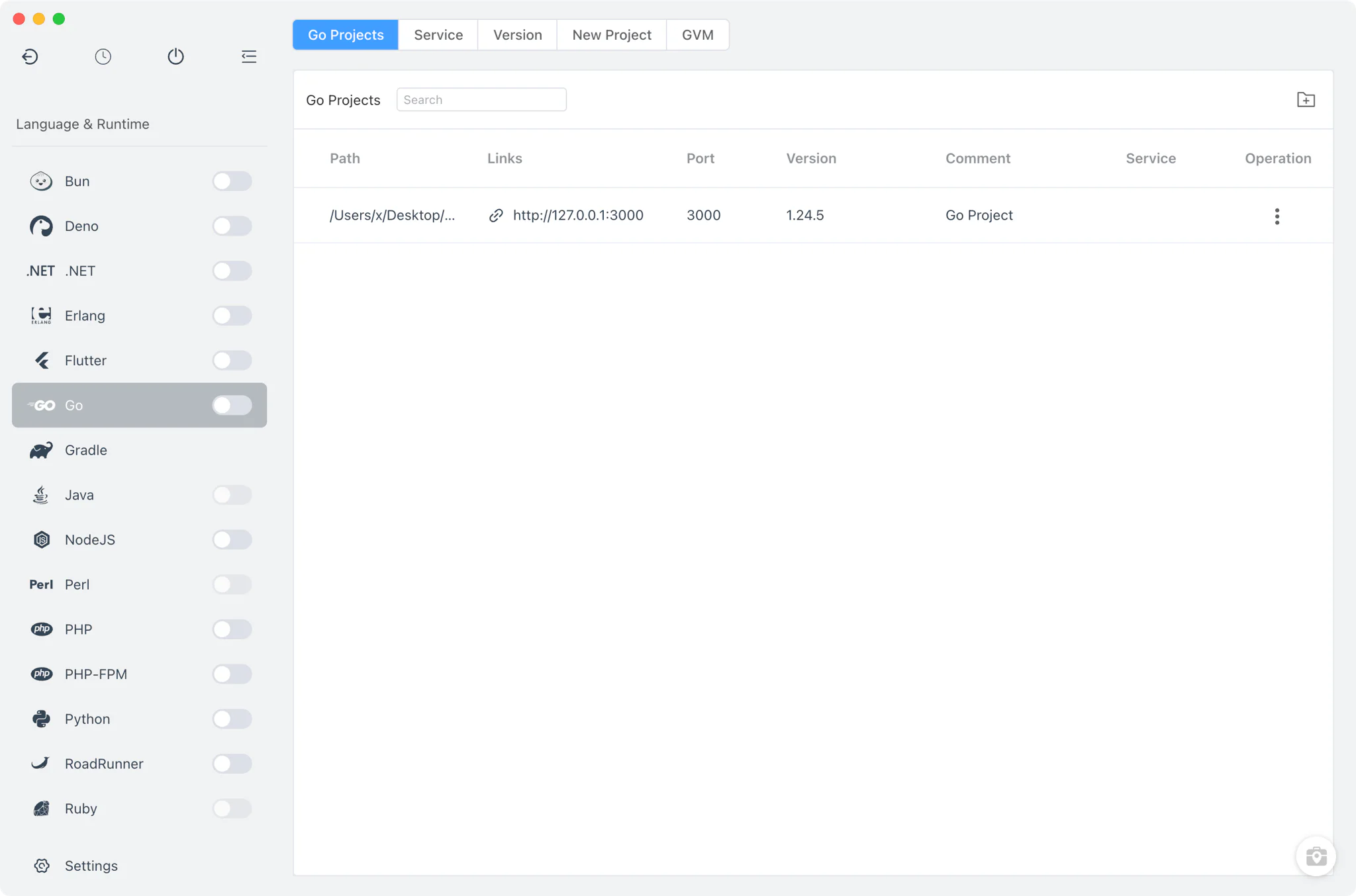
Go version management
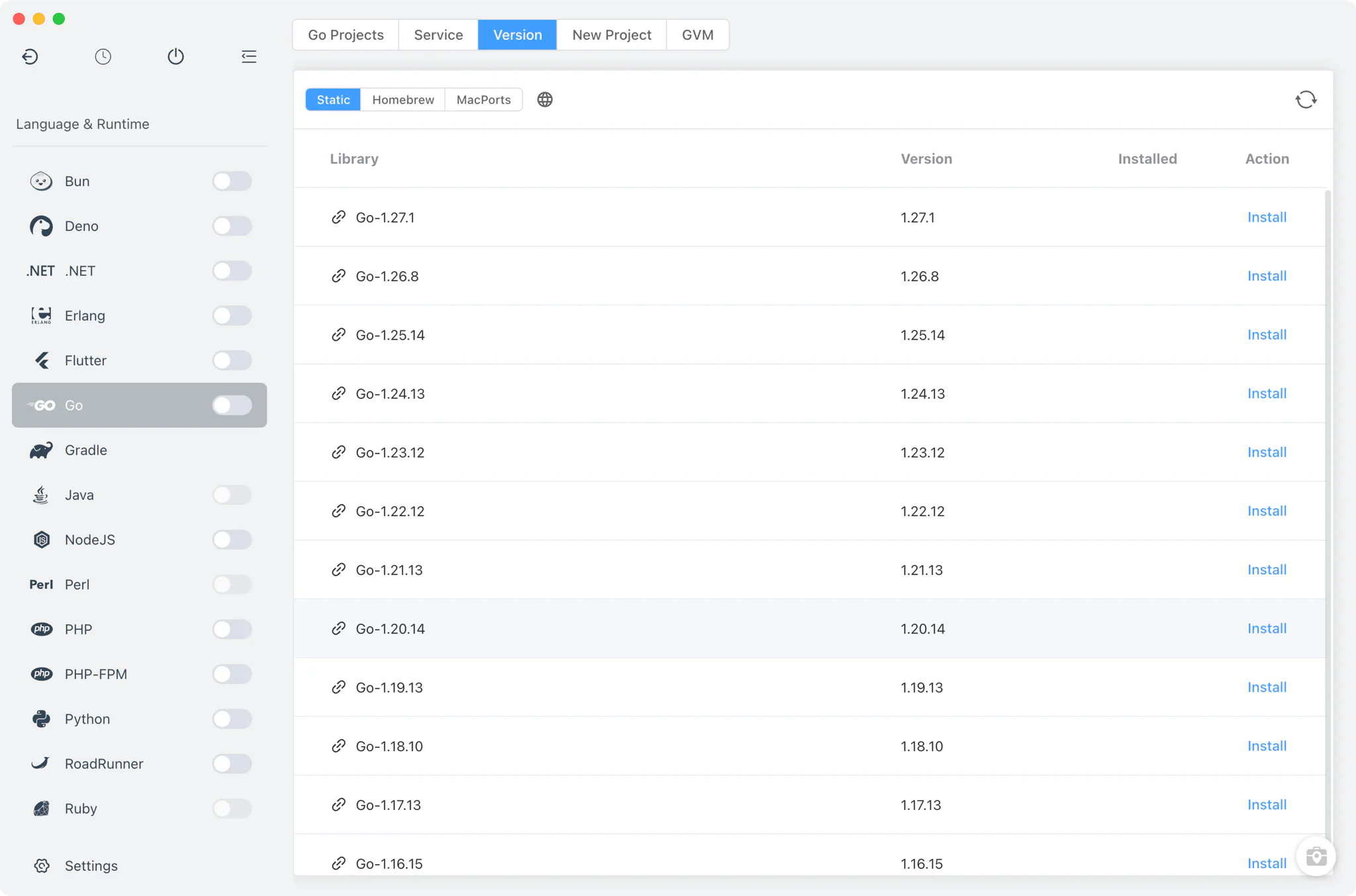
Install Go versions side by side from Go → Version Manager and keep them all available at once. gradle.md
- Static builds on every platform: FlyEnv downloads official Go releases —
.tar.gzarchives from the go.dev release list on macOS and Linux, zip packages on Windows — and unpacks them into its own managed directory. - Package-manager sources: on macOS you can also install the
goformula from Homebrew or MacPorts; on Linux, Homebrew is available as an additional source. - Custom directories: point FlyEnv at any directory containing your own Go build and it appears in the list next to the managed versions.
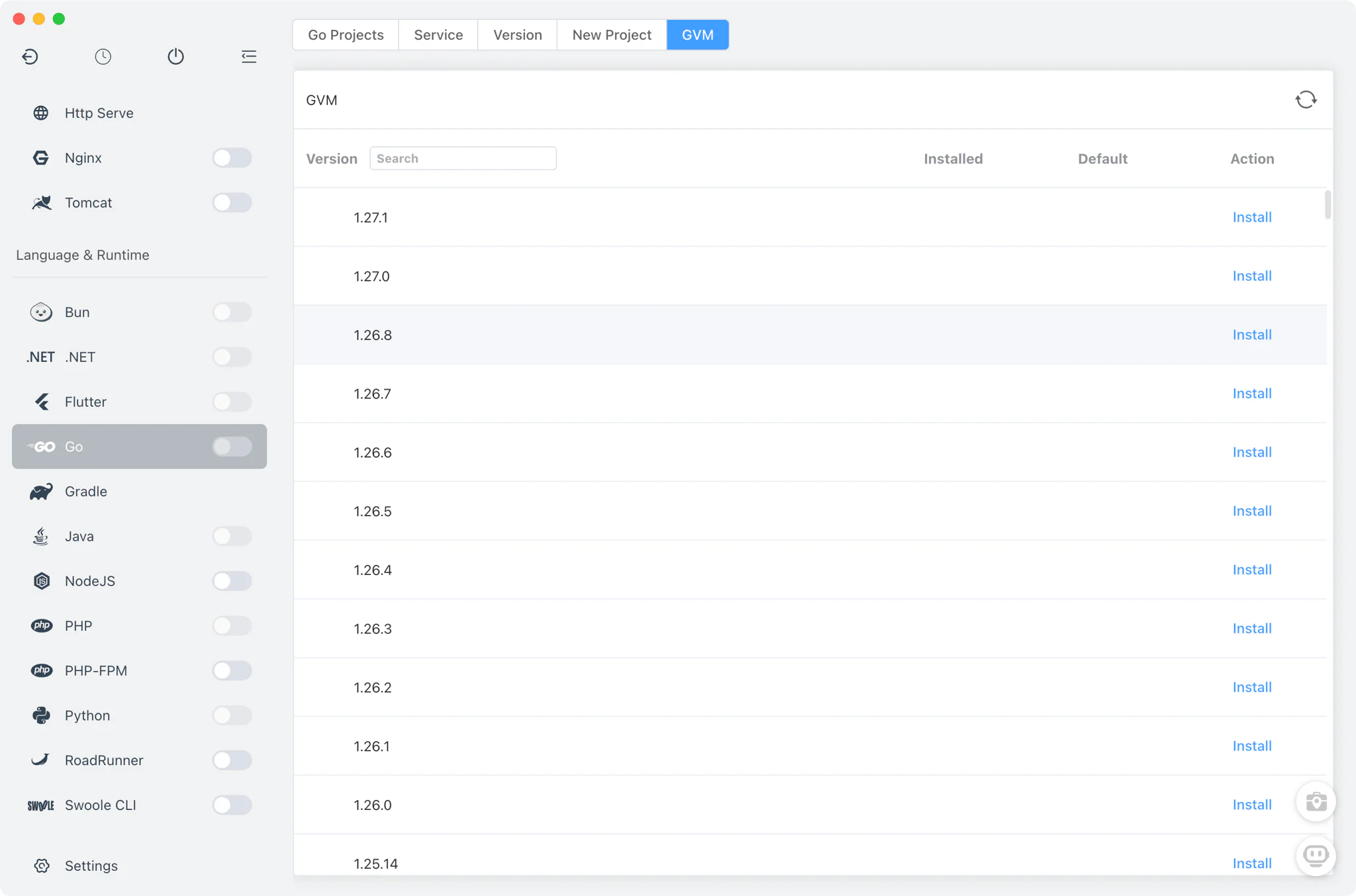
- GVM discovery: on macOS and Linux, FlyEnv automatically finds Go versions installed through GVM and lists them alongside the managed ones.
On macOS and Linux, the dedicated GVM tab integrates with an existing GVM installation directly: FlyEnv detects GVM in ~/.gvm or via GVM_ROOT, offers a one-click GVM install in its embedded terminal when none is present, and lists the GVM-managed versions with install and use actions.
Command-line version switching
The name Service is misleading for Go: this tab never starts or stops anything, because FlyEnv runs no Go daemon. What you get is a table of installed versions with PATH management built in.
- Terminal version switching: pick the installed version your terminal
gocommand should resolve to. FlyEnv rewrites yourPATHby adding or removing the version's bin directory, and labels each entry so you can tell whether FlyEnv or another tool put it there. - Per-version alias and remark: attach a short alias and a free-form note to any installation, which keeps similar builds distinguishable in the list.
- Housekeeping: install paths are shown right in the table, and versions you no longer need can be deleted from the same place.
Project-level Go runtimes
In Go → Projects, register each project folder and bind it to a specific Go version instead of relying on whichever version happens to be in PATH. The project-level runtime environment guide explains the mechanism in detail.
- Per-project runtime: the version choice is stored in a
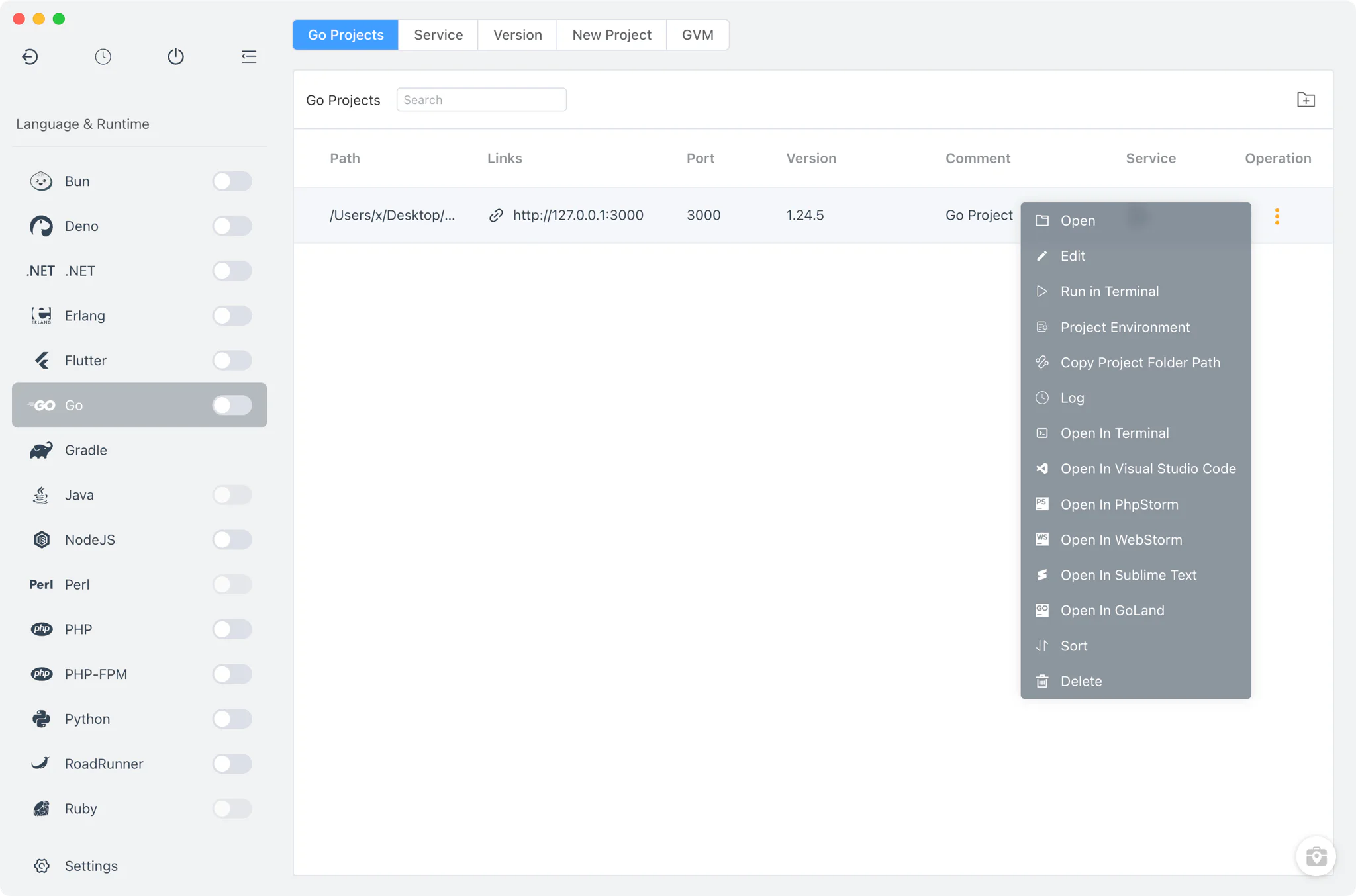
.flyenvfile inside the project directory, so terminals and editors launched from FlyEnv pick up the right Go toolchain automatically. - Run as service: optionally run a project directly from FlyEnv with a custom run command or run file, a project port exposed as a
http://127.0.0.1:<port>link, environment variables set inline or from an env file, and a sudo toggle on macOS and Linux. To put that port behind a local domain with HTTPS, the reverse proxy guide covers the Nginx, Apache and Caddy setup. - Open-in tools: jump from a project row into the system terminal or open the project in GoLand with its environment loaded.
- New Project templates: scaffold a plain
go mod initmodule or a project based on Gin, Echo, Fiber, Iris, GoFrame or Buffalo without leaving the app. The Gitea solution shows a production-grade Go application served through FlyEnv's site management.
For running these projects as persistent background services, see the guide on deploying Node.js, Python and Go projects without Docker.
Related guides, solutions and demos
Continue with a practical guide, solution, demo, or community perspective.
Compatibility Notes
FlyEnv manages Go version installation, PATH switching and project runtimes; it does not bundle framework tooling beyond what each Go build and the Go module ecosystem itself provide. Available install sources differ per platform — the GVM tab and GVM auto-discovery exist on macOS and Linux only, while Windows uses Static builds — so treat the Download page and current release notes as the source for supported packages.