Laravel Herd
Optimized around Laravel development (macOS / Windows)
Laravel Site
my-app.test · PHP 8.4 pinned per site
Herd Pro services
Managed services for the site
herd.yml shares the Laravel environment; Forge integration handles deployment.
Comparison
Laravel Herd provides one of the most polished local development workflows for Laravel and PHP developers, with first-party ecosystem integrations such as Forge, herd.yml and Reverb. FlyEnv takes a broader approach: one local development workspace for PHP, Node.js, Python, Go, Java and infrastructure services across different kinds of projects.
Optimized around Laravel development (macOS / Windows)
Laravel Site
my-app.test · PHP 8.4 pinned per site
Herd Pro services
Managed services for the site
herd.yml shares the Laravel environment; Forge integration handles deployment.
One workspace across different stacks (macOS, Windows, Linux)
Laravel · Project
Node.js App · Project
Java App · Project
Laravel, Node.js, Java and more — each project keeps its own stack in one app.
Both run fast, native PHP environments. The real difference is what each product is centered around.
Herd is built around Laravel, PHP, Composer, Forge, Reverb and herd.yml. FlyEnv covers Laravel too, but also WordPress, Node.js, Python, Go, Java / Tomcat and self-hosted apps like ERPNext, Gitea or Keycloak. The difference is not feature count — it is the center of the product.
Herd offers first-party Laravel integration: Forge deployment, herd.yml, Reverb and Laravel-focused tooling. FlyEnv instead offers broader runtime families, more database and service modules, multiple web servers, bundled database GUI tools and Startup Groups.
Laravel conventions reduce setup work for Laravel projects: parked directories, per-site PHP versions and herd.yml come out of the box. FlyEnv instead lets you choose and combine runtimes, web servers, databases and services according to each project’s stack — Laravel or not.
Same purpose, different development scope.
Laravel-first, per-site PHP (macOS / Windows)
Laravel project
Laravel Herd
▸PHP 7.4–8.5, pinned per site
▸Nginx with automatic .test domains
▸herd.yml shared environment config
▸Laravel Reverb and Herd Pro services
▸Laravel Forge deployment integration
One workspace across different stacks
Laravel
Nginx
PHP 8.4
MySQL
Redis
Node.js App
Caddy
Node.js
PostgreSQL
MinIO
Java App
Tomcat
OpenJDK
MySQL
Redis
See the same setup in FlyEnv's runtime, Host, and service workflows.

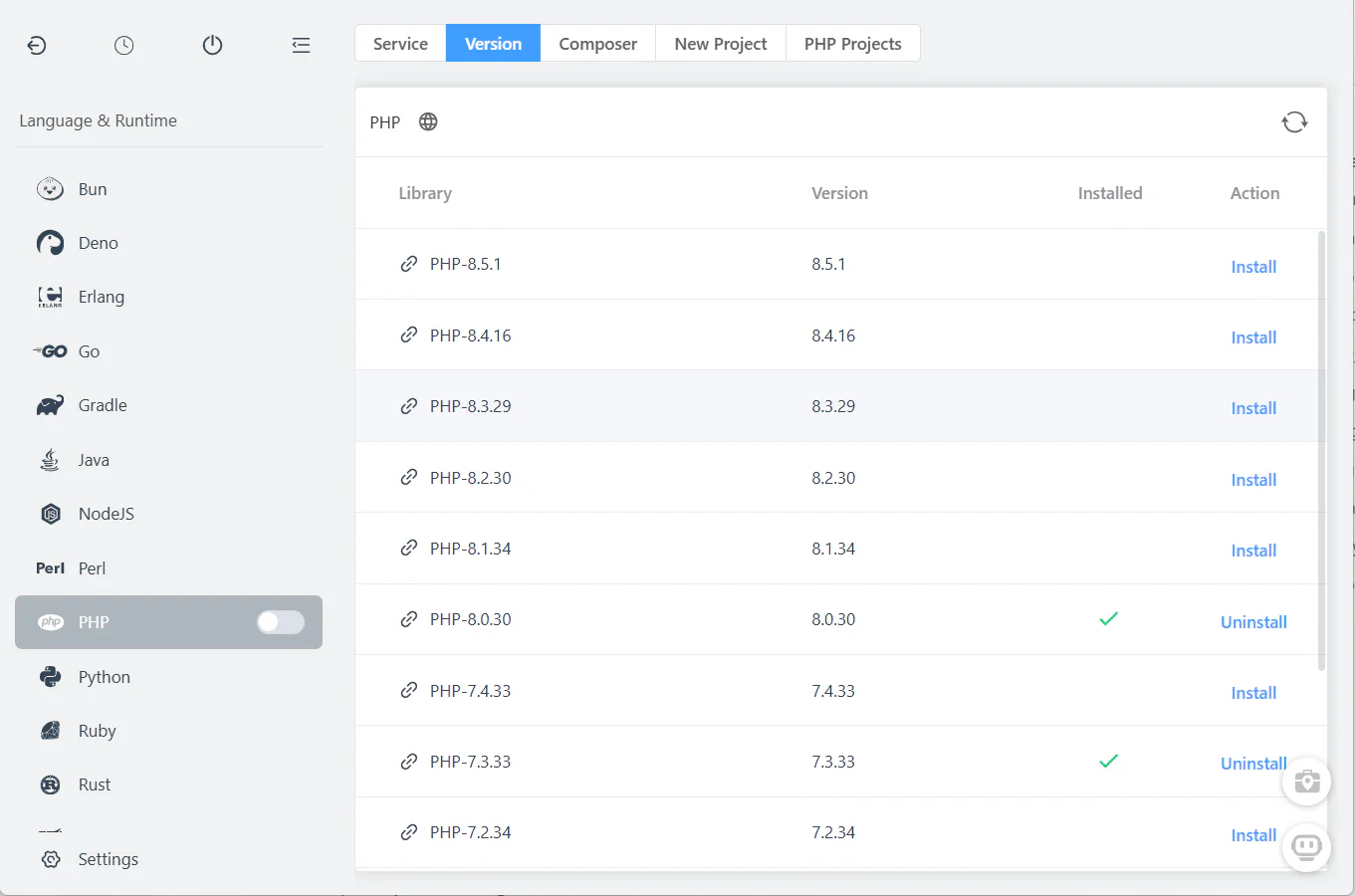
Install and manage PHP, Node.js, Python, Go and Java versions side by side, and use whichever runtime each project needs.

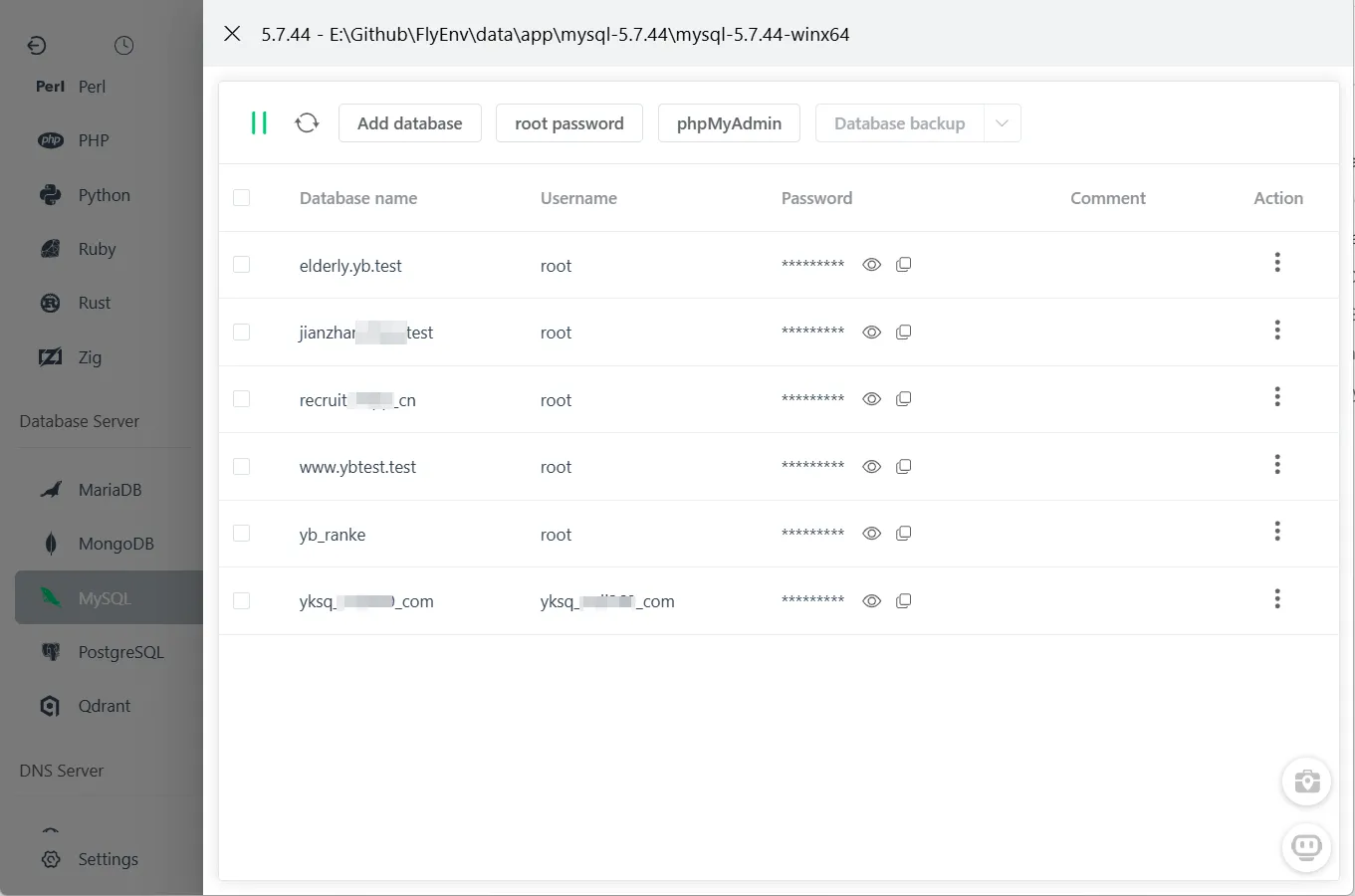
Databases, Redis, object storage, mail testing and search engines run as managed modules next to your projects.

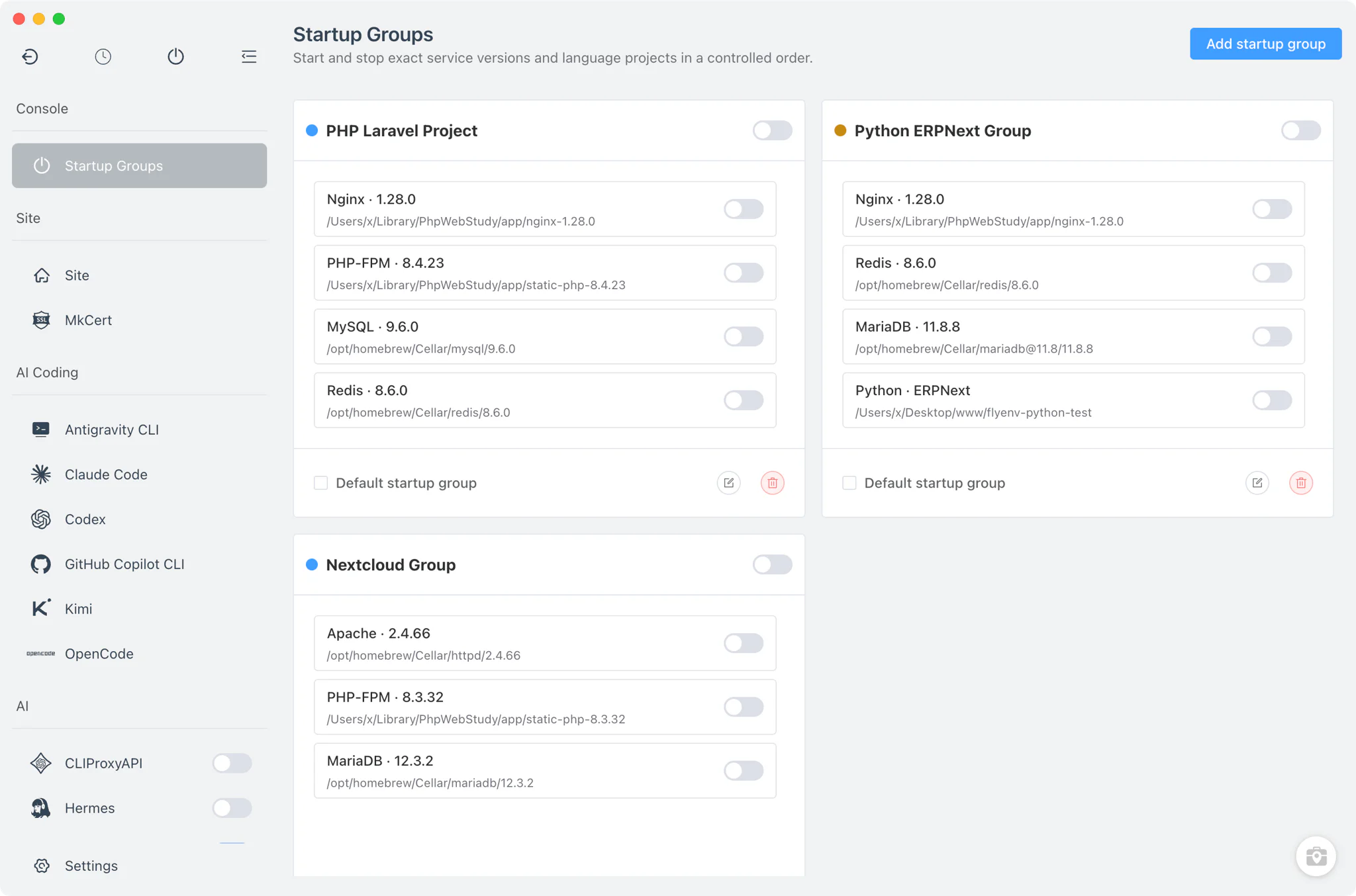
Start PHP, MySQL, Redis, Mailpit and the other services a project depends on together with a Startup Group — one click starts the whole stack.
A practical comparison of commonly used capabilities.
| Capability | Laravel Herd | FlyEnv |
|---|---|---|
| Platforms | AvailablemacOS, Windows | AvailablemacOS, Windows, Linux |
| PHP versions | AvailablePHP 7.4–8.5 with per-site pinning | AvailableMultiple managed versions, assigned per project |
| Node.js / other runtimes | AvailableNode.js via nvm (Herd Pro); PHP-focused overall | AvailableNode.js, Python, Go, Java, Ruby, Rust and more |
| Web servers | AvailableNginx | AvailableNginx, Apache, Caddy |
| Databases | AvailableMySQL, MariaDB, PostgreSQL, MongoDB (Herd Pro) | AvailableMultiple built-in database modules |
| Redis / cache | AvailableVia Herd Pro services | AvailableBuilt-in Redis and Memcached modules |
| Search engines | AvailableTypesense, Meilisearch (Herd Pro) | AvailableMeilisearch, Typesense and more |
| Object storage | AvailableMinIO, RustFS (Herd Pro) | AvailableManaged MinIO / RustFS modules |
| Local domains and HTTPS | AvailableAutomatic .test domains and local HTTPS | AvailableCustom domains and HTTPS per project |
| Laravel ecosystem integration | Availableherd.yml, Laravel Forge, Laravel Reverb | Not included |
| Mail testing | AvailableBuilt-in SMTP mail catcher and email client (Herd Pro) | AvailableBuilt-in Mailpit module |
| Startup groups | Not included | AvailableBuilt-in project services |
| Database GUI tools | LimitedNo bundled GUI; herd db opens site databases in clients like TablePlus | AvailablephpMyAdmin, pgAdmin, DbGate and more |
| AI / MCP integration | AvailableBuilt-in MCP server (herd-mcp) for AI coding agents | AvailableFlyEnv MCP Server and AI CLI modules |
A side-by-side look at the same kind of work.
With Laravel Herd
Create or open the Laravel project
With FlyEnv
Laravel project → PHP, Nginx, MySQL and Redis
With Laravel Herd
Herd serves the site with its pinned PHP version
With FlyEnv
Node.js app → Node.js and PostgreSQL
With Laravel Herd
Start the Herd Pro services the app needs
With FlyEnv
Python app → Python and Redis
With Laravel Herd
Share the environment via herd.yml and Laravel tooling
With FlyEnv
Java app → Tomcat and MySQL
With Laravel Herd
A Node.js or Java project is outside Herd’s primary workflow — another tool covers that stack
With FlyEnv
Manage all of them from the same workspace
Both tools can be useful; the right choice depends on your workflow.
If nearly all of your work is Laravel, Herd is the more specialized tool. If your week spans several stacks, one workspace matters more than Laravel-specific extras.
Not necessarily. If you mostly build Laravel applications on macOS or Windows, Herd is an excellent, deeply integrated tool. FlyEnv becomes more useful when you work across several languages and frameworks, need Linux support, or want more infrastructure modules built in.
Yes. FlyEnv runs complete Laravel stacks: multiple PHP versions, Nginx, Apache or Caddy, MySQL, MariaDB, PostgreSQL, Redis, queues and local domains with HTTPS. What it does not include is Laravel-specific tooling such as herd.yml or Forge integration.
For local development, largely yes. MySQL, MariaDB, PostgreSQL, MongoDB, Redis, MinIO, RustFS, Typesense and Meilisearch are available as built-in FlyEnv modules rather than a paid add-on tier, and FlyEnv’s Mailpit module covers the same local mail testing as Herd Pro’s mail server. Herd Pro also includes Laravel-specific extras like Reverb and the debug dump window, which FlyEnv does not replicate.
No. herd.yml and Forge integration are Laravel-ecosystem features of Herd. FlyEnv instead uses per-project site configuration and Startup Groups to keep each project’s services together.
Yes. FlyEnv manages Node.js, Python, Go, Java and other runtimes next to PHP, so non-Laravel projects live in the same workspace as your Laravel apps.
Yes. FlyEnv supports macOS, Windows and Linux. Laravel Herd currently supports macOS and Windows.
Yes. Point a FlyEnv local site at your existing project directory, pick the PHP version and services it needs, and keep working — no application rewrite is required in most cases.
Yes. Some developers keep Herd for Laravel-focused work and use FlyEnv for Node.js, Java, Python or infrastructure-heavy projects. Just avoid running two web servers or databases on the same ports at the same time.
Keep Laravel, Node.js, Python, Go, Java and their local services in one development workspace.